

The CORE Programme presented at IADR 2025
Barcelona, Spain
June 2025

Gallery
.png)

The CORE Programme Management Group attended the 2025 International Association for Dental Research (IADR) General Session and Exhibition held on the 25th to 28th June in Barcelona, Spain. Several members of the CORE Consortium and international collaborators attended the conference to present a combination of oral and poster presentations of some key elements of the programme work.
Professor Carol Guarnizo-Herreño and Dr. Michelle Stennett presented a poster displaying the overall development and structure of the CORE Programme. The research work packages were outlined, alongside key elements of the training and capacity building, community engagement and involvement, and monitoring, evaluation and learning components.
.jpeg)
Professor Ankur Singh presented simulation modelling findings, generated as part of the CORE Programme research work package on oral health inequalities. The modelling analysed the overall population oral health impacts and oral health inequality impacts of sugar taxation, sugar sweetened beverage taxation, and motivational interviewing targeting sugar consumption on adults in the USA. The results indicated that population-level preventive interventions, such as sugar sweetened beverage taxation, reduce both oral diseases and social inequalities in oral health.
Dr. Francine Costa also presented analysis produced as part of the CORE Programme research work package on oral health inequalities. Her cross-sectional analysis of data from nationally representative surveys focused on wealth inequalities in the lack of functional dentition among adults aged 20 years or older from thirty-seven countries. Her findings showed significant variation in the magnitude of disparities in the lack of functional dentition across world regions, countries, and socioeconomic groups, with the poorest adults and older adults over the age of 60 being disproportionately affected.
Professor Regina Mutave presented the Kenyan findings from an exploratory qualitative study conducted as part of the CORE Programme research work package on oral health inequalities. The study focused on amplifying voices of individuals often ‘unheard’ in oral health research by exploring their lived experiences of oral disease and access to oral health services. In Kenya, the study focused on the perspectives of street families located in the Grogon area of Nairobi. Professor Mutave discussed the pervasive oral health impacts, systemic barriers, and social stigma affecting Nairobi’s street families, as well as the resilience demonstrated through the use of traditional remedies to address oral diseases.
.jpeg)
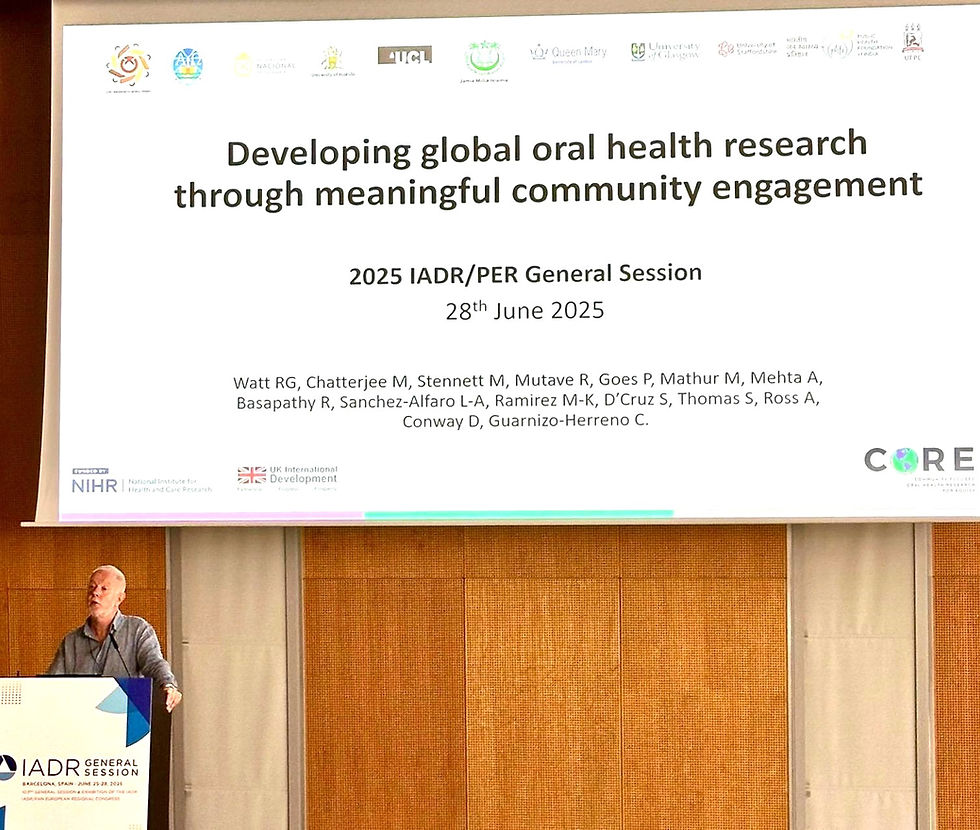
Professor Richard Watt provided an overview of the development of the community engagement and involvement (CEI) component of the CORE Programme. He outlined the initial community mapping exercises and community visits conducted in each country to better understand the resources, needs, and experiences of local communities. The community mapping exercises underlined the importance of developing trust, understanding, and mutual respect with communities; as well as having awareness of context specific community dynamics. He concluded with a summary of the planned community engagement activities across all CORE Programme partner countries; including community forums, community link workers, visual and performing arts events, and development of a community engagement toolkit based upon the experiences gained in the CORE programme.
The IADR General Session 2025 was a wonderful opportunity for the CORE Programme to showcase and disseminate research findings to the wider academic community and also to build engagement and interest in the programme activities.